Can you improve digital maturity without first understanding how health and care staff experience the technology they’re using every day?
That question stayed with me throughout this week’s KLAS Arch Collaborative Learning Summit in Salt Lake City.
Bringing together around 350 delegates, 85 health systems and over 20 technology partners, the event showcased organisations at different stages of their digital journeys. There was plenty of discussion around Ambient AI, governance, training, optimisation and clinician experience.
But what struck me most wasn’t the technology.
It was the mindset.
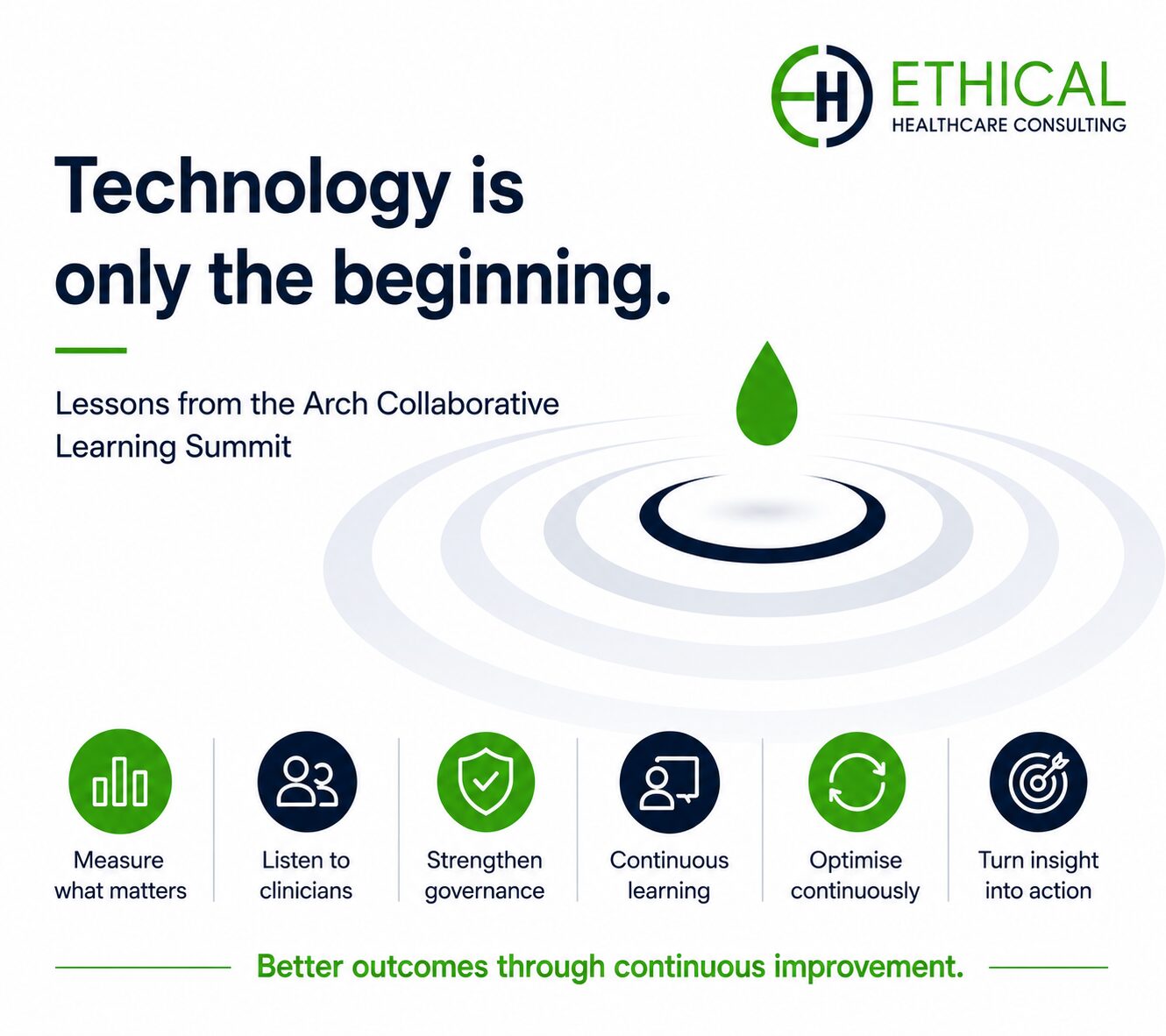
Go-live isn’t the finish line
One message came through in almost every session:
Change management doesn’t stop at go-live.
It sounds simple, but it’s a challenge many health and care organisations continue to grapple with.
The highest-performing organisations weren’t talking about successful implementations. They were talking about what happened six months, a year and even two years later.
How they continued to train people.
How they measured clinician experience.
How they refined workflows.
How they governed change.
How they kept listening.
One phrase I hadn’t heard before particularly resonated with me: “governance drift.”
It’s the gradual erosion of good decision-making once implementation teams move on and everyday pressures take over. I suspect many NHS organisations will recognise that challenge.
Measurement only matters if it leads to action
Another consistent theme was the way organisations use data.
The Arch Collaborative has built an impressive benchmarking programme, but what interested me wasn’t the scores themselves.
It was what organisations did next.
The most successful healthcare systems aligned clinician surveys with operational measures, shared the findings openly, created multidisciplinary workgroups and prioritised improvements based on what clinicians were actually experiencing.
The survey wasn’t the end of the process. It was the beginning of the conversation.
Several presenters emphasised the importance of going back to staff and showing exactly what had changed because of their feedback. That simple step built trust, encouraged future participation and created genuine ownership of improvement.
Is AI succeeding because of the technology…or the foundations?
Unsurprisingly, Ambient AI featured heavily throughout the conference.
The benefits being reported were significant: reduced documentation burden, improved clinician experience and measurable gains in efficiency.
But I found myself asking a different question.
Are these organisations succeeding because they introduced Ambient AI?
Or because they already had strong governance, well-designed workflows, engaged clinicians and a culture of continuous optimisation?
The technology may be accelerating improvement, but many of these organisations had already invested years in building the foundations.
That feels particularly relevant for the NHS.
As more organisations explore AI, it’s worth remembering that technology rarely fixes weak processes. Without good governance, effective training and clinician engagement, there’s a risk of building on unstable foundations.
Beyond the technology
Perhaps my biggest takeaway wasn’t about AI at all.
It was about the value of bringing organisations together to learn from one another.
The Arch Collaborative isn’t simply a benchmarking programme. It’s a community where health and care systems openly share what’s worked, what hasn’t and what they’ll do differently next time. That openness accelerates improvement for everyone.
As I flew home, I found myself thinking less about the technology and more about the approach.
As the NHS continues to invest in digital transformation, perhaps we should be asking not only how we measure digital maturity, but how we create more opportunities to learn from one another.
Of course the biggest gains don’t come from implementing an EPR or introducing AI.
They come afterwards—through listening to staff, refining workflows, investing in people and committing to continuous improvement.
Perhaps that’s the biggest lesson from Salt Lake City.
Technology will always evolve but the greatest opportunity is to learn together.
Finally, don’t forget to register your interest in attending the National EPR Usability Summit using the form below.